Why the Meta pixel cannot see Amazon sales
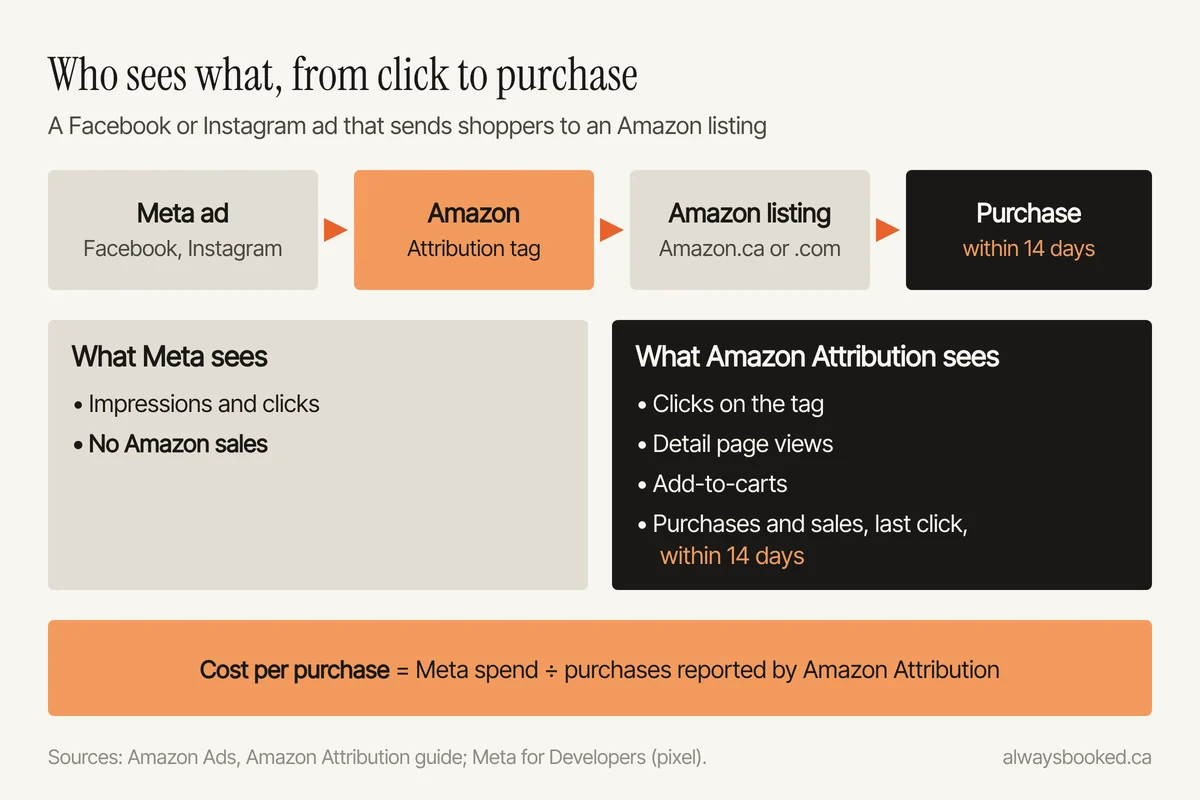
The Meta pixel only measures pages whose code you control. An Amazon listing is not one of them, so when your ad sends a shopper to Amazon, Meta never sees the purchase.
Meta lists access to your website's code as a requirement for installing the pixel (Meta for Developers), and Amazon does not give sellers that access. Meta sees impressions and clicks, never the cart or the sale, so a campaign optimized for purchases has nothing to learn from.
Measurement happens on Amazon's side, with an Amazon Attribution tag: a tracking link that replaces your listing URL in the ad. Amazon counts what happens after the click, and you match those numbers to your Meta spend.
Amazon.ca vs Amazon.com: what Amazon offers
Amazon Attribution works on both Amazon.ca and Amazon.com. The Brand Referral Bonus is described by Amazon for its US store only.
Amazon Attribution is free for professional sellers enrolled in Brand Registry, vendors, KDP authors and agencies whose clients sell on Amazon, and its country list includes Canada and the United States (Amazon Ads). It reports clicks, detail page views, add-to-carts, purchases and sales, including new-to-brand customers and other products from your brand (the "brand halo"). It uses "a 14-day, last-touch attribution model": the most recent click gets the credit if the purchase happens within 14 days (Amazon Attribution guide).
The Brand Referral Bonus averages 10% of qualifying sales from your off-Amazon marketing, including other products from your brand bought within 14 days of the click (guide). It builds up as credits that offset future referral fees, with the full amount credited after two months. The rate varies by category and price, and Amazon's own ads do not qualify (Sell on Amazon).
What about Canada? Every Amazon page I read that names a marketplace points to the US store: the Attribution guide offers the bonus to "US seller brand owners", the August 2022 announcement lists only the United States, and an Amazon representative on the Amazon.ca seller forums wrote that brand owners selling in Amazon's US store are eligible to enrol. The Amazon.ca Brand Registry page names the bonus without saying it pays on Canadian sales. I could not confirm it for Amazon.ca: check Seller Central before you count on it.
| What Amazon offers | Amazon.ca | Amazon.com |
|---|---|---|
| Amazon Attribution (free) | Yes | Yes |
| Attribution window | 14 days, last click | 14 days, last click |
| Brand Referral Bonus | Not confirmed by Amazon | Yes: 10% on average, credited after two months |
| Meta pixel on the listing | Not possible | Not possible |
Amazon.ca's 10% back on your first $70,000 in branded sales is a different incentive: the same page lists it under new seller incentives and does not tie it to off-Amazon marketing.
Amazon.ca says every new selling subscription includes access to Amazon.com, Amazon.ca and Amazon.com.mx (Amazon.ca). If you also sell in the US, run one ad set per country, each pointing to its own marketplace: US sales are where the bonus can lower your cost.
Setup checklist: one tag per ad set
Use at least one Attribution tag per ad set, pasted into the URL of every Meta ad in it. Otherwise it all adds up and you cannot tell which audience buys; Amazon itself suggests one tag per marketing tactic. Before the first dollar, check:
| Step | Tool | What to check |
|---|---|---|
| 1. Enrol your brand | Brand Registry | Pending or registered trademark from a country with an Amazon store; you hold the brand representative role |
| 2. Open Amazon Attribution | Amazon Ads | The right marketplace: Amazon.ca, Amazon.com or both |
| 3. Check the products | Seller Central | In stock, with images and a price, or Amazon will not measure them |
| 4. Create the tags | Amazon Attribution | One per ad set and country, or one per ad when testing creative; a bulk file handles up to 8,500 Facebook or Instagram ads |
| 5. Paste the tags | Meta Ads Manager | In place of the Amazon URL in each ad; click to test |
| 6. Pick the objective | Meta Ads Manager | Traffic for a direct link; Sales only with your own page and the pixel |
| 7. French for Quebec | Meta Ads Manager | For a Quebec business, a French version at least as accessible as the English one |
| 8. Compare weekly | Spreadsheet | Spend per ad set, purchases per tag, cost per purchase |
Traffic or Sales: direct link or landing page
If the ad links straight to Amazon, use the Traffic objective. Sales, the other one of Meta's six objectives that matters here, only makes sense with your own landing page, where the pixel can record the click through to Amazon.
- Direct link, Traffic objective. The fastest setup: the tag is the ad's URL. Jon Loomer reports on his blog an Ads Manager notice that reads: "Maximize landing page views will now work without needing to install a pixel on your website." He sees an opening for Amazon sellers and believes some of those views are modelled; I could not check this on Meta's own site. The catch: Meta looks for people who click, not people who buy.
- Your landing page, Sales objective. The "Buy on Amazon" button carries the Attribution tag, and the pixel records its click as a conversion. You gain a page you control and retargeting audiences; you lose shoppers who drop off at the extra step. In Quebec, the pixel must wait for consent: the Commission d'accès à l'information, the privacy regulator, states that technologies able to identify, locate or profile a person cannot be activated by default (CAI). My guide to Law 25 on WordPress covers the consent banner.
The rule: launching in less than a month, or no site ready? Link direct. A site with a consent banner and several products to compare? Use a landing page.
What to measure, with a worked example
The number that decides is cost per purchase: Meta spend divided by the purchases Amazon Attribution reports, compared with your margin per unit after Amazon fees. ROAS (sales ÷ spend) completes the picture.
Purchases can be credited up to 14 days after a click, so let that window close before you cut a new ad set.
Apart from Amazon's average bonus rate and the $450 management fee, every number here is an example input, including the $1.00 cost per click, and the math ignores the exchange rate, although Amazon.com sells in US dollars.
| Step | Calculation | To Amazon.ca | To Amazon.com |
|---|---|---|---|
| Meta budget for the month | Example input | $1,500 | $1,500 |
| Clicks | $1,500 ÷ $1.00 per click (example) | 1,500 | 1,500 |
| Attributed purchases | 4% of clicks (example) | 60 | 60 |
| Attributed sales | 60 × $50 (example price) | $3,000 | $3,000 |
| ROAS | $3,000 ÷ $1,500 | 2.0 | 2.0 |
| Brand Referral Bonus | 10% of sales on average | $0 (not confirmed) | $300 in credits, two months later |
| Net cost per purchase | ($1,500 minus bonus) ÷ 60 | $25 | $20 |
| With $450 management | ($1,500 minus bonus, plus $450) ÷ 60 | $32.50 | $27.50 |
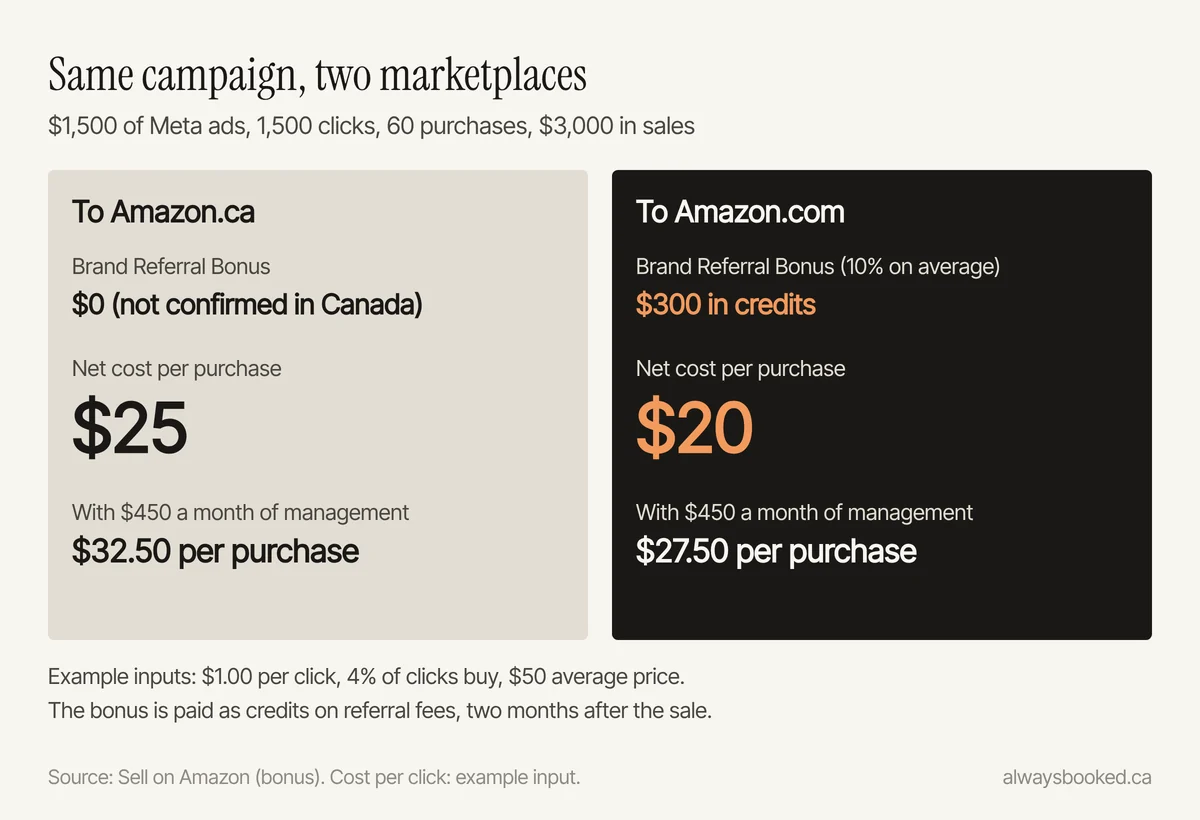
With a $25 margin per unit after Amazon fees (example), the Amazon.ca campaign just pays back the ads; the Amazon.com one also covers two thirds of the management. At $15, neither pays for itself on the first purchase: fix the targeting or the offer, and read the new-to-brand and brand halo reports.
Black Friday timing and the rules that still apply
Black Friday falls on November 27, 2026, and Cyber Monday on November 30. To have reliable numbers by then, create your tags and start testing in early November.
- By November 6: Brand Registry checked, tags created, enough stock (an out-of-stock product is no longer measured).
- November 6 to 20: test two or three audiences while the 14-day window closes.
- November 27 and 30, then December: move budget to the ad sets that sell.
- Late January 2027: Brand Referral Bonus credits for Black Friday sales on Amazon.com, given the two-month wait.
Three rules apply even when the sale happens on Amazon:
- French in Quebec. In March 2025, the OQLF wrote to a Montreal merchant, about its Facebook and Instagram accounts, that under section 52 of the Charter of the French Language it is against the law to make a commercial post available on social media if it is not in French (OQLF letter, in French). Another language is allowed when the French version is accessible on terms at least as favourable. More in my French guide to Facebook ads for small businesses.
- Strike-through prices. "Was $49.99, now $29.99" claims a regular price. The Competition Bureau's two tests are "More than 50% of sales of the product were at that price or higher within a reasonable period" or "The product was offered for sale, in good faith, at that price or higher for a substantial period of time", usually within a year before or after the promotion (Competition Bureau). The rule sits in section 74.01 of the Competition Act.
- Amazon's rules. Since October 2016, Amazon has banned reviews written in exchange for free or discounted products, except through its Vine program (Amazon): never offer anything for a review. Its brand usage rules bar the Amazon logo from sellers' ads that link to Amazon, but allow the "available at Amazon" logo without approval (Amazon Ads).
This is general information, not legal advice.
What Always Booked does
Facebook and Instagram ads management at Always Booked costs from $900 for setup, then $450 a month, month to month; you pay the ad budget directly to Meta. For a brand sold on Amazon, I set up and manage the Meta side (ad sets by country, ads in English and French), place the Attribution tags in each ad and, every month, adjust the campaigns by comparing spend with what Amazon reports. With a $1,500 budget, the first month costs from $2,850 in total, then from $1,950 a month, before taxes. In Montreal? See my page on Facebook ads management in Montreal.
Questions
Can I put the Meta pixel on my Amazon listing?
No. The pixel needs access to your website's code, and Amazon does not give sellers that access to its pages. Amazon Attribution tags do the measuring instead.
Is Amazon Attribution available on Amazon.ca?
Yes. Amazon lists Canada among its Attribution countries. It is free for professional sellers enrolled in Brand Registry, vendors, and agencies whose clients sell on Amazon.
Do Canadian sellers get the Brand Referral Bonus?
For sales in Amazon's US store, a brand enrolled in the program can earn it, at 10% of sales on average. For Amazon.ca sales, I found no Amazon page that confirms it, so check Seller Central before you build it into your numbers.
How long after a click does Amazon credit a sale to my ad?
Up to 14 days. Amazon Attribution gives the sale to the most recent tagged click before it; a purchase made after that window is not counted.
Do my ads need to be in French?
If your business is in Quebec, yes for Quebec audiences: the OQLF applies section 52 of the Charter of the French Language to commercial posts on Facebook and Instagram. English versions can run too if the French one is at least as accessible.
Want this done for you?
Facebook & Instagram ads: from $450 / month. A 15-minute call to see if it is a good fit.
Sources
- Amazon Ads, Amazon Attribution (product page and FAQ)
- Amazon Ads, Basics of Amazon Attribution (guide)
- Amazon Ads, Brand Referral Bonus in Amazon Attribution reporting (August 5, 2022)
- Sell on Amazon, Brand Referral Bonus (October 20, 2023)
- Amazon.ca, Brand Registry
- Amazon.ca, brand benefits
- Amazon.ca seller forums, Amazon post on the Brand Referral Bonus
- Meta for Developers, Meta Pixel: get started
- Meta for Developers, simplifying campaign objectives (December 21, 2021)
- Jon Loomer, Landing Page Views No Longer Require a Pixel
- CAI, main changes under Law 25 (in French)
- OQLF, letter of March 27, 2025 on social media and section 52 (in French)
- Competition Bureau, Businesses: make sure your Black Friday deals are real (November 25, 2025)
- Competition Act (current to September 30, 2026)
- Amazon, update on customer reviews (October 3, 2016)
- Amazon Ads, Amazon brand usage guidelines for third-party advertising